
The outbreak of peace
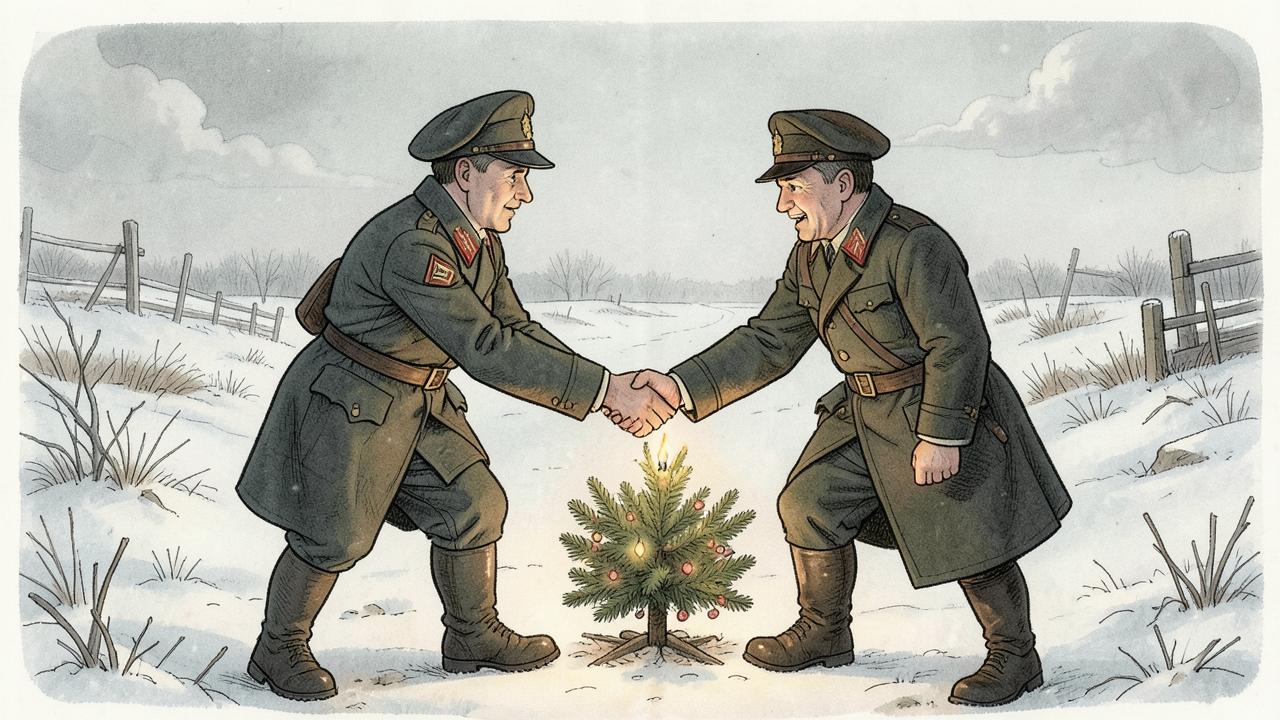
By December 1914, the First World War had been raging for five months, and the initial hopes of a quick victory had been replaced by the grim reality of trench warfare. Along parts of the Western Front, the heavy rains of November had turned the battlefield into a quagmire, leading to a temporary lull in the fighting. On Christmas Eve, a remarkable event occurred: German soldiers began placing candles and small fir trees on their parapets and singing carols like 'Stille Nacht' (Silent Night). British troops responded by singing 'First Noel', and soon, voices were calling out across the narrow strip of No Man's Land. This spontaneous, unofficial ceasefire was not ordered by the generals but was a grassroots movement by the soldiers who shared a common exhaustion and a shared desire for a moment of humanity.
Exchanges in No Man's Land
On Christmas Day, hundreds of soldiers from both sides climbed out of their trenches and met in the middle of No Man's Land. They shook hands, exchanged small gifts like cigarettes, plum puddings, and uniform buttons, and in some cases, shared photographs of their families. One of the most significant aspects of the truce was the opportunity it provided to bury the dead who had been lying in the frozen mud between the lines; joint funeral services were held, with soldiers from both sides standing together in respect. While the famous story of a full-scale football match between the British and Germans is perhaps an exaggeration of smaller, informal kickabouts, the core of the event was a genuine, if brief, recognition of their shared humanity in the face of industrialised slaughter.
The reaction of the High Command
The Christmas Truce was a cause for great alarm among the military leadership on both sides. Generals at GHQ were horrified by the idea of 'fraternisation' with the enemy, fearing it would undermine the 'fighting spirit' and discipline of the troops. In the weeks that followed, strict orders were issued to prevent any repeat of such events, with threats of court-martial for anyone who attempted to communicate with the enemy. The war soon intensified, with the introduction of poison gas and the massive, bloody offensives of 1915 and 1916, which made the kind of empathy seen in 1914 much harder to sustain. The truce remains a powerful symbol of the potential for peace, but it also highlights the way in which modern warfare is controlled and directed by those far removed from the front lines.
Evidence and the historian's task
Historians piece together the story of the Christmas Truce primarily through the private letters and diaries of the soldiers who were there. Many of these accounts were sent home and published in local newspapers, providing a vivid and immediate record of the event. However, these sources must be treated with caution; soldiers may have exaggerated their experiences to impress their families, and the censorship of mail was not yet as strict as it would later become. There is also a lack of official military records of the truce, as commanders were keen to downplay or ignore the breach of discipline. By comparing British, German, and French accounts, historians can verify that the truce did happen in many sectors, while acknowledging that in others, the fighting continued without interruption, reminding us that there is rarely a single, uniform experience of any historical event.