
Medieval justice and ordeals
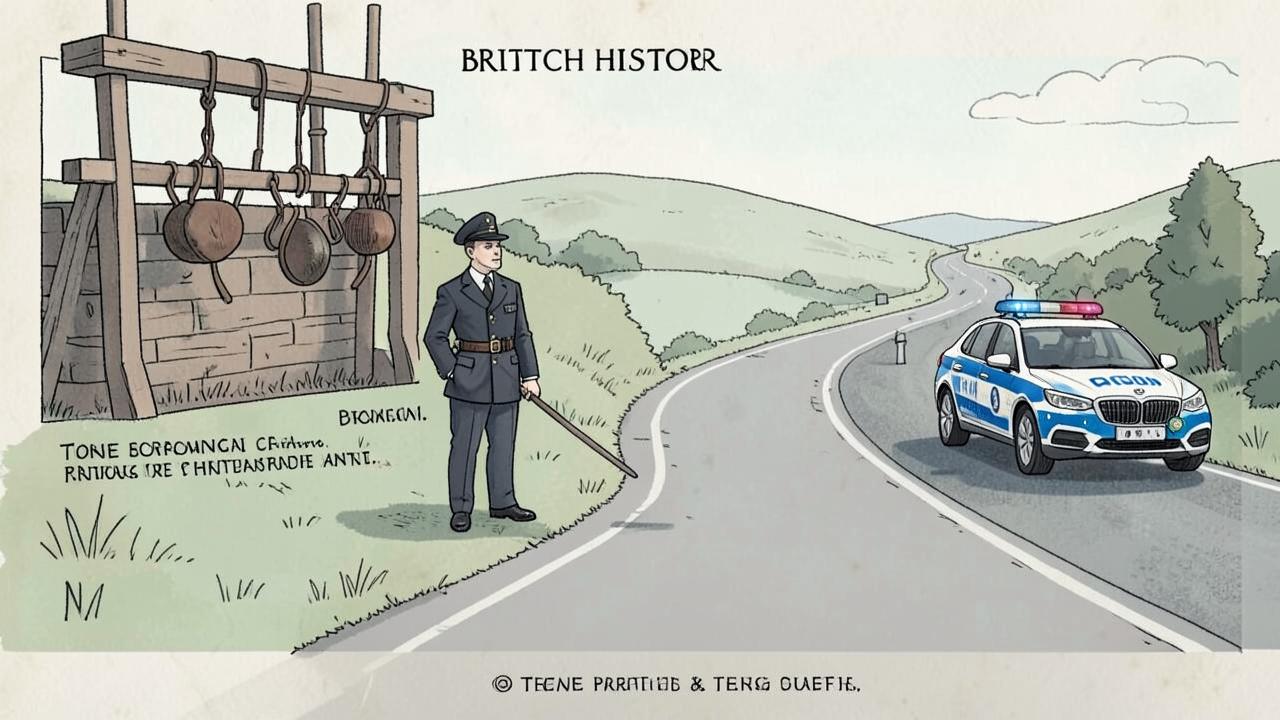
In the early Middle Ages, British justice was deeply tied to the idea of divine intervention. When a local community could not agree on a person's guilt or innocence, they might turn to 'trial by ordeal'. This could involve the accused carrying a piece of red-hot iron or reaching into boiling water to retrieve a stone. The wound was then bandaged and checked three days later; if it was healing cleanly, it was taken as a sign from God that the person was innocent. For less serious crimes, the community enforced its own order through the 'tithing' system, where groups of ten men were responsible for each other’s behaviour. If one committed a crime, the others had to bring him to justice or pay a fine, ensuring that everyone had a personal stake in maintaining the peace.
The Bloody Code and Transportation
By the late 18th century, the English legal system had become famously severe, a period historians call the 'Bloody Code'. Over 200 offences—including stealing a sheep, cutting down a tree, or even being in the company of gypsies—carried the mandatory death penalty. The government believed that the threat of public execution was the only way to deter crime in a rapidly growing and changing society. However, juries were often reluctant to hang people for minor thefts, leading to the rise of 'transportation' as an alternative. Convicts were shipped thousands of miles to colonies in America, and later Australia, where they were forced to work for a set number of years. This served the dual purpose of punishing the criminal and helping to build the infrastructure of the growing British Empire.
Victorian Prison Reform
The 19th century saw a major shift in how the state thought about punishment. Influenced by reformers like Elizabeth Fry and John Howard, the focus moved from physical punishment and public spectacle toward the reform and rehabilitation of the prisoner. The 'separate system' was introduced, where prisoners were kept in individual cells to reflect on their crimes in silence and avoid the 'moral contagion' of other criminals. Pentonville Prison, built in 1842, became the model for this new approach. While this was intended to be more humane than the gallows, the extreme isolation often led to mental health crises among inmates. The abolition of public hanging in 1868 marked the end of an era where punishment was a form of public entertainment, moving the operation of the law behind closed doors.
Evidence and the historian's task
Historians study the history of crime and punishment using a vast range of records, from the detailed transcripts of the Old Bailey in London to local parish records and the personal accounts of prisoners and reformers. These sources provide an incredibly detailed look at the lives of ordinary people who are often missing from other historical narratives. However, historians must be aware of the bias in these records; court transcripts were written by officials and may not accurately capture the voice or the intent of the accused. Furthermore, the official records of 'successful' reforms often mask the harsh reality of prison life. By comparing the high-minded goals of reformers with the data on reoffending rates and the testimony of those who experienced the system, historians can develop a more critical view of how 'justice' has been defined and delivered over time.