
The religious context of death
For the Ancient Egyptians, death was not an end but a transition to a new and eternal life. They believed that a human consisted of several parts, including the 'ka' (life force) and the 'ba' (personality), which needed to be reunited with the physical body after death. For this to happen, the body had to remain recognisable and preserved, which is why the process of mummification became so central to their culture. The entire procedure was a deeply religious ritual, overseen by priests who wore the mask of Anubis, the jackal-headed god of embalming. Every step was accompanied by prayers and incantations intended to protect the deceased on their perilous journey through the underworld, known as the Duat, where they would ultimately face the weighing of the heart by the god Osiris.
The embalming process
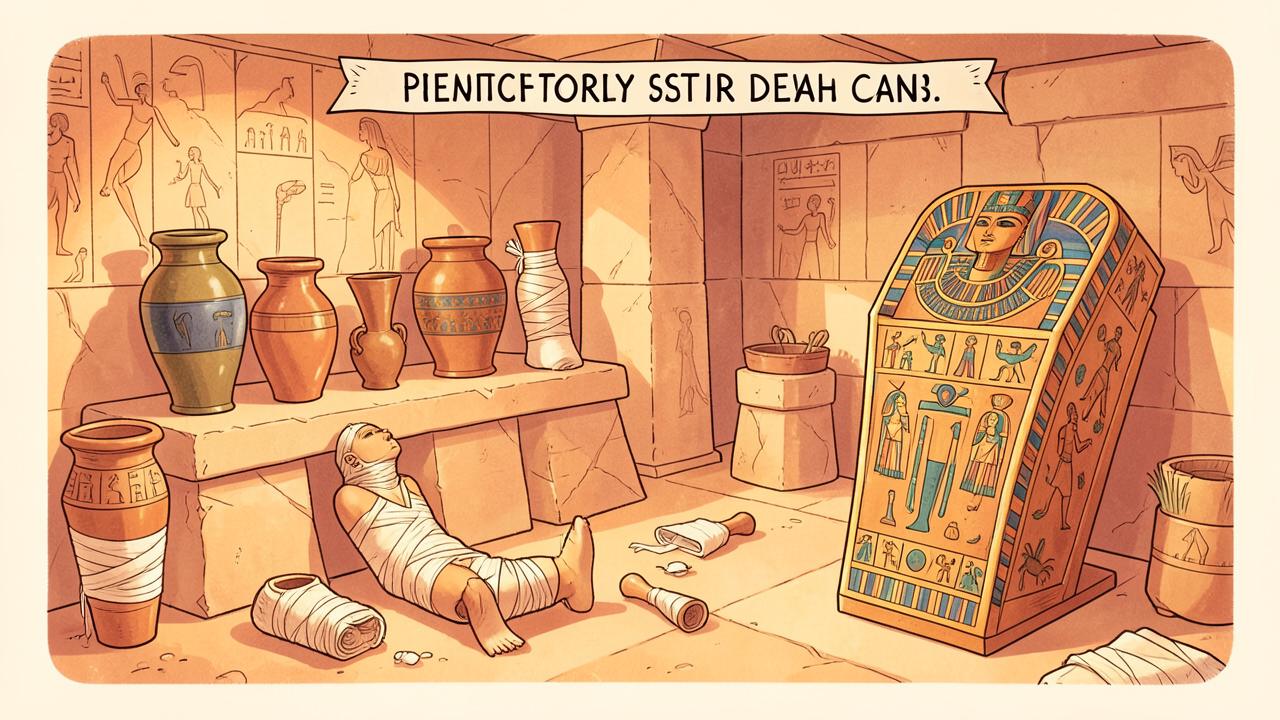
The mummification process was a highly skilled craft that took approximately 70 days to complete. The first stage involved the removal of the internal organs, which were the first to decay. A hooked tool was used to carefully extract the brain through the nostrils, after which it was usually discarded. An incision was made in the left side of the body to remove the stomach, intestines, lungs, and liver, which were then preserved in four special containers called canopic jars. Crucially, the heart was left inside the body; the Egyptians believed it was the centre of intelligence and emotion, and it would be needed by the deceased in the afterlife to be weighed against the feather of truth. The body was then packed with natron—a natural salt—and left to dry out for 40 days, a process that removed all moisture and prevented rot.
Wrapping and protective amulets
Once the body was thoroughly dried, it was cleaned, rubbed with fragrant oils, and stuffed with sawdust or linen to restore its shape. The final stage was the elaborate wrapping in hundreds of yards of fine linen bandages. This was not just for preservation but was also a ritual process; as the priests wrapped the body, they tucked small charms called amulets between the layers. These included the 'djed' pillar for stability and the 'ankh' for life. A final protective mask, often made of cartonnage or even gold for royalty, was placed over the head to ensure the soul could recognise its body. The completed mummy was then placed in a series of nested coffins and a stone sarcophagus, ready to be interred in a tomb filled with everything the person would need for their eternal life.
Evidence and the historian's task
Historians and archaeologists learn about mummification from three main sources: the discovery of actual mummies, the wall paintings in Egyptian tombs, and the accounts of ancient Greek historians like Herodotus. While Herodotus provides a detailed description of the process, he was writing centuries after the peak of the Egyptian empire and may have misunderstood or exaggerated certain details. Modern science has revolutionised this field through the use of CT scans and DNA analysis, which allow researchers to study mummies without damaging them by unwrapping. These scans reveal the health, diet, and even the causes of death of ancient people, providing a scientific check against the ancient written accounts. By combining these different types of evidence, historians can separate religious myth from biological reality, though many secrets of the embalmer’s art remain undiscovered.