
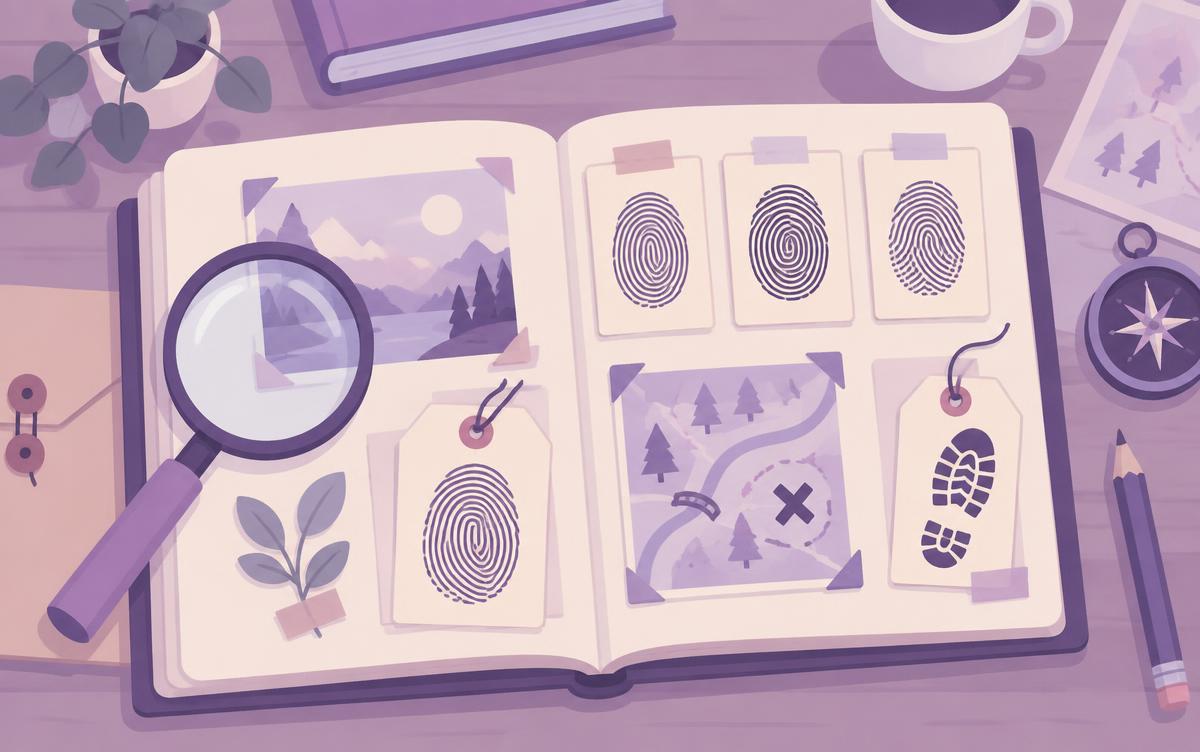
The Detective's Casebook
Train as a detective on an invented practice case — fingerprints, ink, alibis and codes — then weigh the real evidence in a 500-year-old royal mystery.
What you'll make
A case file for the practice case: an evidence log, a decoded message, and a written verdict — plus a careful evidence-based verdict on a real historical mystery.
What you'll learn
- The difference between an observation, an inference and a guess
- Why fingerprints vary between individuals and how they are compared
- How chromatography separates inks, and why it works (KS3 mixtures and separation)
- How to build a timeline, spot contradictions and weigh evidence
- How historians and investigators reach conclusions they can defend — and admit the limits of
You'll need
A pencil and a notebook or the on-screen answer boxes · One dark felt-tip or ballpoint pen (three different brands is even better) · Kitchen roll or coffee filter paper, a glass of water, a saucer · An adult nearby for the ink experiment · No-kit option: ready-made (clearly labelled invented) results are provided
The practice case is invented and clearly labelled — no real people in it. The real mystery is over 500 years old and is handled respectfully: no violence, no gore and no upsetting content. Modern missing-person cases appear only through the Missing People charity's public information.
Curriculum links
- Ask questions and develop a line of enquiry based on observations of the real world
- Make and record observations and measurements using a range of methods, and evaluate the reliability of methods
- Interpret observations and data, including identifying patterns and using observations to draw conclusions
- Understand the concept of a pure substance and how mixtures can be separated through filtration, distillation and chromatography
- Understand differences between species and the variation between individuals of the same species
You're not signed in, so work saves on this device only.